

Why most workplace wellbeing strategies fail - and what works instead
Businesses everywhere are rolling out yoga sessions, step challenges, and mindfulness apps in the hope of lifting engagement and reducing turnover. But research suggests many of these efforts fail as they prioritise ‘feel good’ perks as opposed to evidence based approaches, such as manager-led initiatives or values driven, organisation-wide change management programs (1).
To be effective, workplace wellbeing strategies need to go beyond surface level programs. They must go beyond fruit bowls and subsidised gym memberships, and instead be embedded into the way work is designed, led, managed, and measured (2). Done well, such strategies can transform not only employee wellbeing, but also employee commitment to the organisation (3), organisational resilience, productivity, and reputation. (They can even contributing to wider environmental and social goals.)
Why wellbeing strategy matters
The evidence is clear - workplace wellbeing programs are essential, but they need to be designed well:
The World Health Organization (WHO) identifies workplaces as critical settings for health promotion, noting that poorly designed work contributes to chronic disease, stress, and injury (4)
Safe Work Australia estimates that work-related injury and illness cost the Australian economy over AUD $28.6 billion annually (5)
Low wellbeing factors such as poor communication, lack of promotion opportunities, and unmeaningful work reduce wellbeing and significantly increase turnover intention amongst employees (3).
In one Australian study, nearly 1/3 of SME owners / managers reported clinical levels of psychological distress, and almost 50% had experienced a recent stressful workplace incident, underscoring the critical need for workplace wellbeing initiatives (6)
In the United Kingdom, Deloitte found that for every dollar invested in workplace mental health, organisations could expect an average return of AUD $2.30 (7).
Beyond economics, organisations that embed wellbeing demonstrate stronger cultures, improved innovation, and greater capacity to adapt to risk - including changes associated with the transition to carbon neutrality, automation and AI; and climate-related disruptions that are increasingly affecting work.
Core principles of effective workplace wellbeing strategies
The most effective workplace wellbeing strategies share common foundations. They are:
Evidenced based: Grounded in occupational health and safety science, not just trends.
Participatory: Designed with input from employees, leaders, and practitioners.
Systemic: Focused on the organisation’s structures, policies, and leadership practices.
Integrated: Embedded into business strategy, not siloed in HR.
Measurable: Built on clear metrics that track both health outcomes and business performance.
A framework for designing a strategy that works
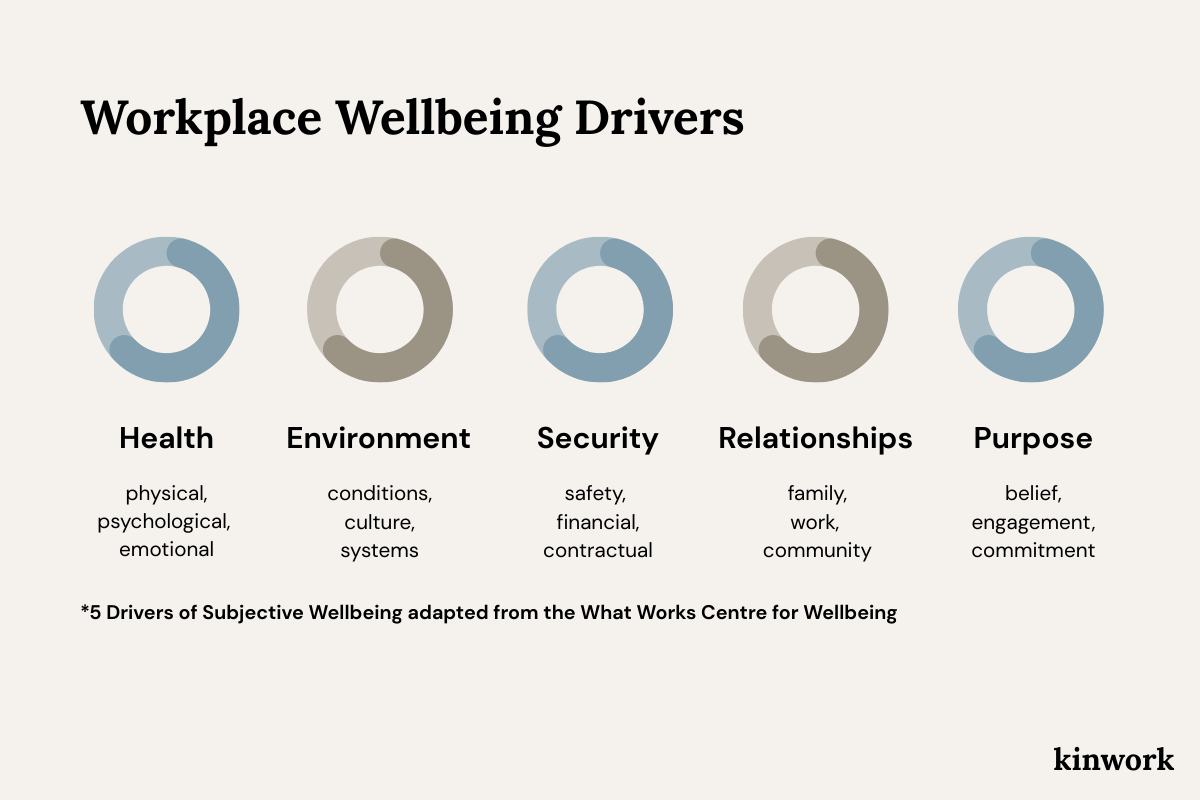
The now retired What Works Centre for Wellbeing identified five drivers of subjective wellbeing that employers could influence: health, relationships, security, environment, and purpose. Effective wellbeing strategies must give equal weight to individual-focused activities (e.g., lifestyle and resilience programs) and organisational-level change (e.g., job design, culture) that consider each of these elements of wellbeing.
Considering the structure of best practice models (e.g., WHO Healthy Workplace Framework (4), ISO 45003 (8)), we recommend the following stepwise approach:
1. Assess needs and risks
Begin with a holistic assessment of workforce health, psychosocial risks, and environmental factors. This includes traditional OHS risks, but should also consider lived experience for your specific workforce, as well as issues like climate-related exposures, remote work challenges, AI disruption, and job insecurity.
2. Define purpose and goals
Align wellbeing goals with organisational strategy. Instead of adopting generic targets (such as ‘increase engagement’), set goals that reflect both people and planetary outcomes, such as ‘reduce burnout rates by 20% while embedding low-carbon work practices.’ The more specific the goal, the greater the likelihood of achieving it.
3. Co-design with stakeholders
Engage employees, leaders, HR and unions in the design process. Participation creates ownership and ensures that strategies reflect real needs rather than top-down assumptions.
4. Embed into operations and leadership
Translate goals into policies, leadership behaviours, and day to day practices. For example:
Redesign roles to reduce excessive workload.
Train leaders in trauma-informed, regenerative coaching practices.
Integrating wellbeing KPIs into performance reviews.
The World Health Organization strongly recommends training managers to support workers’ wellbeing and mental health, as evidence shows it not only improves managers’ knowledge, attitudes, and behaviours, but also encourages dialogue and help-seeking amongst employees (9).
5. Monitor, evaluate, and adapt
Use validated tools to measure progress - from employee health surveys to productivity and retention metrics. Report transparently and adapt strategies in response to emerging risks, including climate or economic changes specific to your geographic region.
The tiered model used within public health (i.e., primary prevention, secondary intervention, tertiary rehabilitation) then offers a structured way for organisations to assess gaps and allocate resources (2).
Common pitfalls to avoid
Tick-box programs: Running isolated wellness weeks or perks without addressing systemic issues
Short term, trend driven initiatives pushed by the ‘wellness’ industry: they’re fragmented, can be non-evidenced based, and like tick-box programs, fail to address systemic issues or creating lasting change
Over-focus on individuals: Expecting employees to ‘self care’ without redesigning harmful workloads or environments will fail to have impact, and will continue to expose workers to hazards.
Neglecting psychosocial hazards: Failing to meet legal obligations under standards like ISO 45003 or national WHS laws.
Weaponising wellbeing outcomes: Treating those employees who participate in wellbeing programs (particularly where they discuss lived experience or demonstrate vulnerability) as weak, unwell or flawed
Ignoring climate and sustainability: Overlooking the way environmental risks shape work and wellbeing. The environment directly influences work and wellbeing and should be central to efforts to refine and improve both.
The Kinwork Model: people + planet positive
Traditional wellbeing strategies often stop at individual health. Kinwork takes a broader view: we believe that organisations thrive when they regenerate both human and ecological systems. That means addressing worker wellbeing alongside planetary health - from reducing exposure to climate risks to embedding sustainability in leadership decisions.
By bridging occupational health, coaching, and regenerative business, Kinwork helps leaders design strategies that deliver resilience, trust, and impact.
So now to you:
If you’re a leader or HR executive, book a workplace wellbeing mentoring call with Kinwork to design a strategy that creates measurable impact.
If you’re a practitioner or coach, join our Workplace Health Coach Certification waitlist and be among the first to train as one of Australia’s workplace health coaches.
Together, we can design workplaces that work for organisations, people, and the planet.
References
Molek-Winiarska, D., Leduc, C., & Chomątowska, B. (2023). Alignment of workplace wellbeing initiatives with WHO’s ‘Guidelines for mental health at work’: A secondary data analysis from three years of the pandemic. Management (Split, Croatia), 28(Special Issue), 29-40.
Litchfield, P. (2021). Workplace wellbeing. Perspectives in Public Health, 141(1), 11-12.
Gelencsér, M., Szabó-Szentgróti, G., Kőmüves, Z. S., & Hollósy-Vadász, G. (2023). The holistic model of labour retention: The impact of workplace wellbeing factors on employee retention. Administrative sciences, 13(5), 1-25.
World Health Organization (2010). Healthy workplaces: a model for action.
Safe Work Australia (2022). The cost of work-related injury and disease in Australia
Dawkins, S., Martin, A., Kilpatrick, M., & Scott, J. (2018). Reasons for Engagement: SME Owner-Manager Motivations for Engaging in a Workplace Mental Health and Wellbeing Intervention. Journal of occupational and environmental medicine, 60(10), 917-927.
Deloitte (2020). Mental health and employers: Refreshing the case for investment. Deloitte UK.
ISO 45003:2021 - Occupational health and safety management - Psychological health and safety at work - Guidelines for managing psychosocial risks
WHO, (2022). WHO guidelines on mental health at work