

Transformational vs regenerative leadership coaching - what’s the difference, and why it matters
Organisational leadership is changing.
Gone are the days of control and compliance. Today’s leaders are being called to rise - to lead with purpose, vision, and care (1, 2).
But as work transitions from the industrial to the information age, and more conscious leadership models emerge, so do the questions:
What’s the difference between transformational leadership coaching and regenerative leadership coaching?
Are they the same thing?
Is one more future-fit than the other?
At Kinwork, we believe both are powerful - but they’re not actually the same, with key differences and applications.
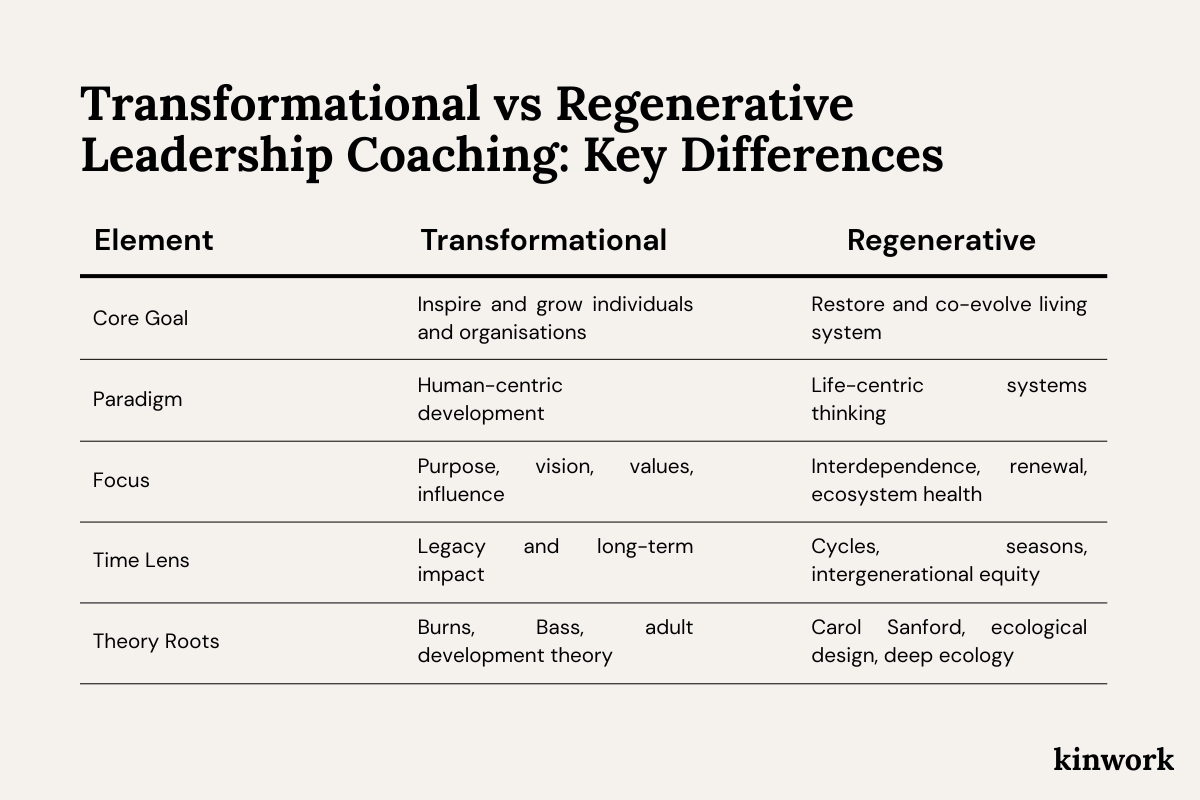
What Is Transformational Leadership Coaching?
Transformational leadership coaching helps individuals, especially founders, managers, and executives, evolve into more self-aware, inspiring, and values-driven leaders. Based on transformational leadership theory (developed by James MacGregor Burns (3) and later expanded by Bernard Bass (4)), this style of coaching approach typically helps clients to:
Discover and lead from purpose
Inspire and motivate others around a shared vision
Grow emotional intelligence and resilience
Unlock innovation and creativity, and
Model integrity and trust.
Transformational coaching is ideal for leaders who want to shift culture, energise teams, and drive meaningful change within their organisation (5, 6).
What Is Regenerative Leadership Coaching?
When compared to transformational leadership, regenerative leadership coaching goes further.
Rooted in living systems thinking, deep ecology, and indigenous wisdom, regenerative coaching doesn’t just aim to improve performance - it helps leaders reimagine their role in restoring and co-evolving with people, place, and planet (1, 2, 7).
This approach invites leaders to:
Lead with life, not over it
Think in cycles, systems, and relationships
Make decisions that regenerate ecosystems, communities, and futures
Build cultures of care, justice, and interdependence, and
Align their organisation with long-term planetary wellbeing
Regenerative coaching is for transformational leaders who want to go beyond shifting culture and driving meaningful change - they want to create conditions where all life can thrive.
Do Transformational and Regenerative Coaching Overlap?
Yes, and beautifully so.
Both coaching styles:
Develop conscious, reflective leaders
Support change in complex, dynamic environments
Prioritise purpose, vision, and care
Challenge outdated, extractive leadership models (1 2, 5)
In fact, many Kinwork clients move from transformational leadership coaching into regenerative leadership work. One opens the door. The other changes the entire whole building for a better future.
Why This Matters for the Future of Work
Transformational leadership coaching helps leaders inspire change within existing organisational goals, improving performance, culture, and engagement inside an operating system that was historically assumed to be stable.
Regenerative leadership coaching goes further, because existing operating models are now the problem - climate transition, AI disruption, psychosocial risk, and rising stakeholder expectations are exposing the limits of extractive ways of working.
They simply no longer work.
Regenerative coaching equips leaders to redesign the conditions of work, not just motivate people within them, strengthening human capability, restoring trust and psychological safety, and aligning decisions with long-term social and ecological limits.
For the future of work, the benchmark isn’t simply transformation (i.e. doing things differently), it’s regeneration (building systems that give back more than they take), so organisations can retain talent, adapt without burning people out, and create lasting value for people, communities, and the planet
Organisations are now being asked to do more than perform. They’re being asked to regenerate and take responsibility for their impact on people and planet, and to redesign work around wholeness, justice, and wellbeing (1, 2).
Leaders can’t do this with old operating models or coaching paradigms - they need new ones that equip them for the pressures and expectations of this moment.
Final Thought
If you’re a founder, leader, or HR practitioner ready to lead differently, you're not alone. You're exactly where this movement begins.
Let’s build what comes next. And let’s make sure it lasts.
References
Aoustin, E. (2023). Regenerative leadership: what it takes to transform business into a force for good. Field actions science reports, Special Issue 25, 92-97.
Balda, J. B., Stanberry, J., & Altman, B. (2023). Leadership and the regenerative economy ‐ Concepts, cases, and connections: Leveraging the Sustainable Development Goals to move toward sustainability leadership. New directions for student leadership, 2023(179), 121-141. https://doi.org/10.1002/yd.20574
Burns, J. M. (1978). Leadership. Harper & Row.
Bass, B. M. (1985). Leadership and performance beyond expectations. Free Press.
Kao, S.-F., Tsai, C.-Y., & Schinke, R. (2021). Investigation of the interaction between coach transformational leadership and coaching competency change over time. International journal of sports science & coaching, 16(1), 44-53. https://doi.org/10.1177/1747954120953946
Lee, M. C. C., & Ding, A. Y. L. (2020). Comparing empowering, transformational, and transactional leadership on supervisory coaching and job performance: A multilevel perspective. PsyCh journal (Victoria, Australia), 9(5), 668-681. https://doi.org/10.1002/pchj.345
Raworth, K. (2017). Why it's time for Doughnut Economics. IPPR progressive review, 24(3), 216-222. https://doi.org/10.1111/newe.12058